AI or human the wrong answer costs you bookings or seeker trust. Here is the exact framework for what to automate and what to keep human in your Ayurveda or wellness center in 2026.
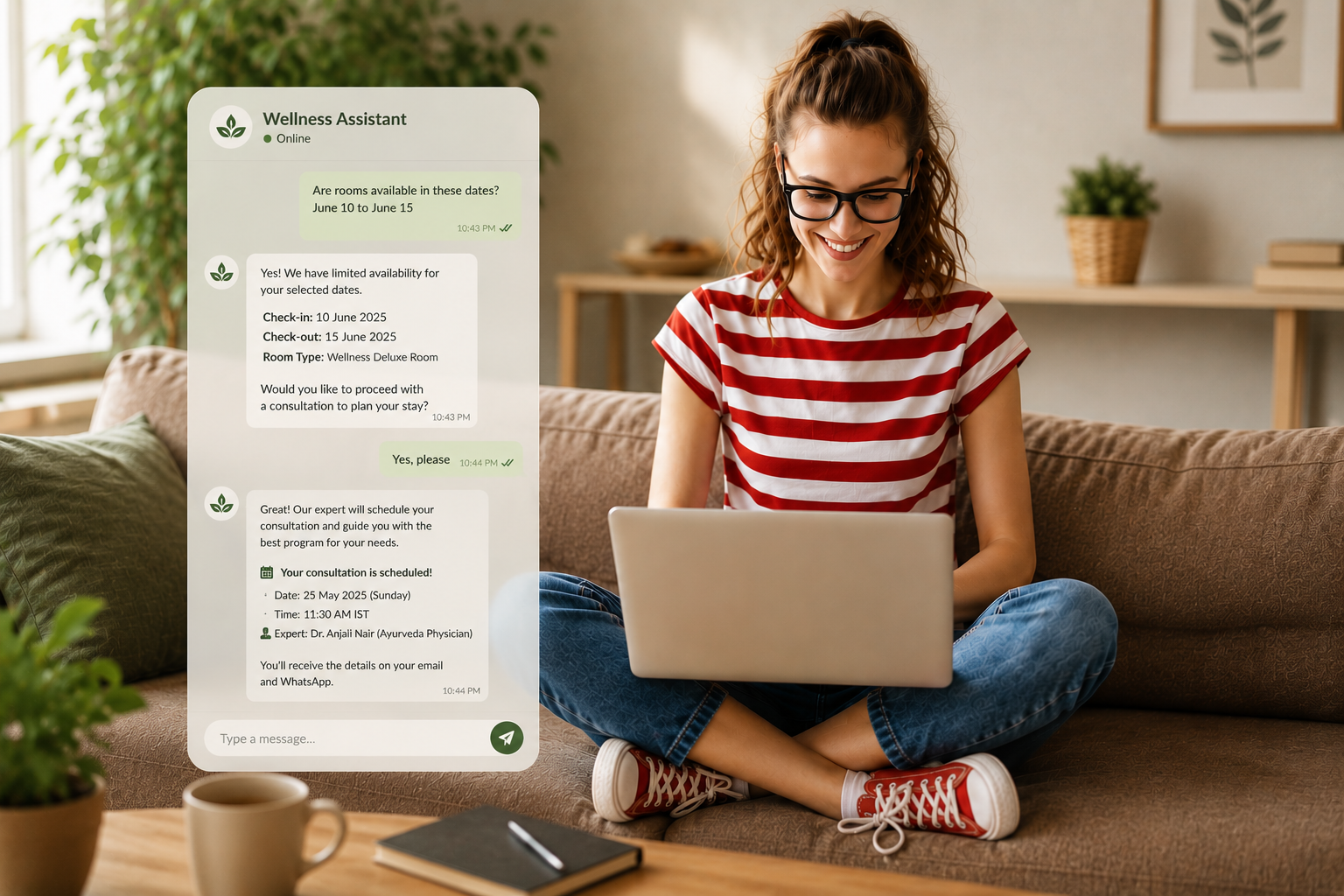
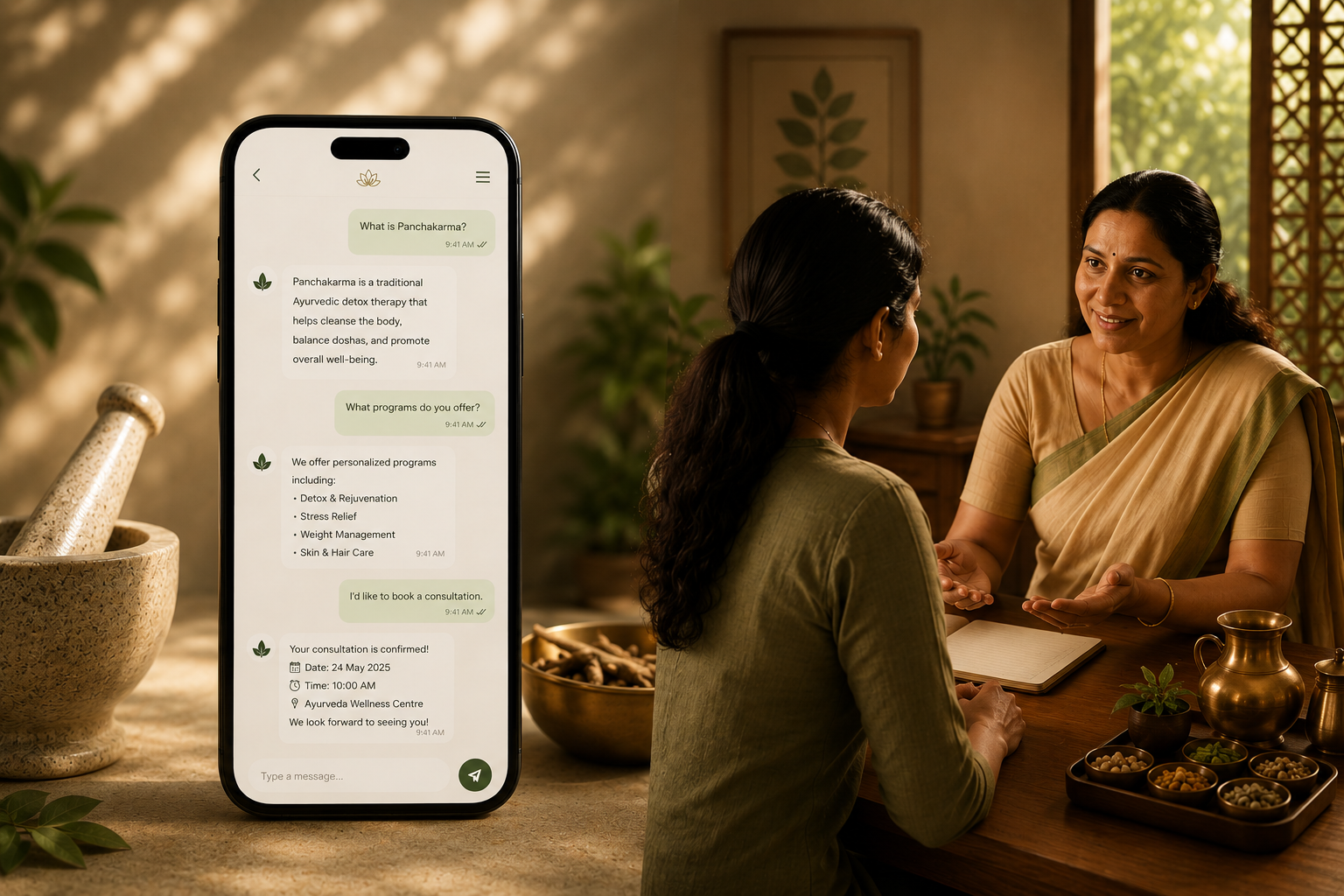
A seeker sends your wellness center a message at 10 PM asking about your Panchakarma program. Your AI chatbot responds within seconds program overview, duration, pricing, and a consultation booking link. She books a slot for the next morning.
Three days later, she messages again. She has been managing a chronic autoimmune condition for two years and wants to know whether Panchakarma is safe for her situation. This time, your chatbot responds with a generic FAQ about program eligibility.
She does not book. She calls a competitor whose team picks up the phone.
This is the most important operational question facing wellness center owners in 2026 not whether to use AI or human support, but where each one belongs. Getting the balance wrong in either direction costs you. Over-automation loses seekers at the moments they need genuine human connection. Under-automation means your team is fielding the same 15 questions every day instead of closing bookings.
75% of CX leaders see AI as a force for amplifying human intelligence, not replacing it. Chatmaxima The wellness centers that are growing fastest in India in 2026 have figured out exactly where that amplification works and where it breaks down. This blog gives you that framework, drawn specifically from the Ayurveda, Panchakarma, yoga, and naturopathy context.
Why the Human vs AI Question Matters More in Wellness Than Anywhere Else
Most industries can afford to over-automate customer support without significant damage to their brand. A seeker choosing an Ayurveda retreat, a 21-day Panchakarma program, or a residential yoga therapy course is not placing an e-commerce order. They are making a health decision often one they have been considering for weeks, sometimes months driven by genuine vulnerability around their physical condition. The trust required to commit to that decision is built through conversation, not through automated responses alone.
79% of Americans strongly prefer interacting with a human over an AI agent in customer service SurveyMonkey, and that preference intensifies in health-sensitive contexts. A seeker asking whether Panchakarma is appropriate for their thyroid condition is not a transaction it is a moment of genuine trust-seeking. If they receive a deflecting chatbot response at that moment, they do not just move to a competitor. They lose confidence in your center's ability to care for them entirely.
At the same time, the cost of under-automating is equally real. Companies using AI have cut first response time by up to 74% within the first year ChatMaxima Blog, and wellness centers that rely entirely on manual responses are losing high-intent seekers every evening, every weekend, and every public holiday to centers that are simply more available. The answer is not AI or human. It is AI first, human when it genuinely matters and a clear, deliberate line between the two.
A wellness resort in Udaipur found this balance after a year of trial and error. They had initially deployed a generic chatbot that handled all inquiries including complex health questions with generic deflections. Seeker trust dropped and consultation bookings fell. They then removed the chatbot entirely and went back to manual handling. Response times suffered and after-hours leads went cold. The third approach a wellness-trained chatbot for routine inquiries with clear escalation to their clinical team for health-sensitive conversations delivered the results they were looking for. After-hours bookings recovered and their team's consultation quality improved because they were no longer fielding repetitive FAQ messages all day.
- Wellness seekers make trust-driven, high-consideration decisions automation that erodes trust costs bookings, not just satisfaction scores
- Over-automation at health-sensitive moments is the most common and most damaging mistake wellness centers make with AI
- Under-automation means lost after-hours leads, slow responses, and team time wasted on repeatable FAQ handling
- The right model is hybrid: AI handles volume, humans handle value with a clean, deliberate handoff between the two
- In 2026, 75% of CX leaders agree the human-AI collaboration model outperforms both full automation and human-only approaches A Panchakarma retreat in Mysuru ran entirely on manual WhatsApp support until mid-2025. Their team was spending four hours daily answering the same questions about program duration, dietary protocols, and pricing leaving little time for consultation follow-up. After deploying a wellness chatbot to handle routine FAQs and first-response inquiries, their team redirected those four hours entirely to consultation calls. Monthly bookings increased by 27% in the first three months not because the chatbot replaced the team, but because it gave the team their time back.
What Should Be Fully Automated: The AI-First Layer
These are the interactions that are high-volume, low-sensitivity, and entirely repeatable. Handling them manually wastes your team's most valuable resource time and creates unnecessary delays for seekers at moments when a fast, accurate response is all they need.
First-response acknowledgment is the single highest-ROI automation for any wellness center. Every seeker who reaches out via WhatsApp, website chat, or contact form should receive an immediate, contextual, warm reply within seconds of their inquiry. Not a generic "we received your message" auto-reply, but a response that directly acknowledges what they asked and tells them what happens next. This single automation closes the after-hours inquiry gap that costs most wellness centers their highest-intent leads every evening.
Program and treatment FAQs are the most time-consuming and most repeatable interactions your team handles. What does the Panchakarma program include? How long is the residential stay? What dietary restrictions apply during treatment? What should a seeker bring? What is the cost of the 14-day versus 21-day program? Is the retreat suitable for vegetarians? These questions have fixed, accurate answers that do not vary by seeker, season, or context. A wellness chatbot trained on your specific programs handles all of them instantly and consistently freeing your team from answering the same questions dozens of times each week.
Lead qualification is where automation delivers its most significant operational impact. When a seeker first contacts your center, a chatbot can ask the right qualifying questions health goal, preferred duration, travel dates, budget range, prior Ayurveda experience and segment each lead automatically before any human gets involved. High-intent seekers are routed to your team immediately with a full briefing. Lower-intent seekers are enrolled in a nurture sequence. Your team starts every morning with a prioritised queue of warm, context-rich leads rather than an undifferentiated inbox.
Consultation booking should require zero back-and-forth between a seeker and your team. A seeker expressing interest in a consultation should be able to self-book a slot in real time within the same conversation, on WhatsApp or your website chat with an automated confirmation and reminder sent immediately. The entire process should take under two minutes with no staff involvement.
Follow-up nurture sequences for seekers who did not convert on first contact should run automatically, delivering relevant content at Day 7, Day 14, and Day 21 without your team manually tracking who needs a follow-up and when. This is the highest-impact automation after first-response for most wellness centers, recovering a meaningful share of leads that would otherwise go cold permanently.
- First-response acknowledgment instant, contextual reply to every inquiry at any hour on any channel
- Program and treatment FAQs accurate, consistent answers to the 15–20 most common seeker questions
- Lead qualification structured conversation that segments seekers and delivers pre-briefed leads to your team
- Consultation slot booking real-time self-scheduling with automated confirmation and reminder
- Follow-up nurture sequences timed, relevant content delivered automatically to all unconverted inquiries
A naturopathy and wellness center in Coimbatore tracked their WhatsApp message volume over 30 days and found that 64% of all incoming messages were one of seven questions about their detox programs. After deploying a wellness chatbot to handle those seven questions, their reception team's time on WhatsApp dropped from 3.5 hours daily to under 45 minutes and the time saved went entirely into consultation follow-up calls, improving their booking conversion rate from 29% to 43%.
What Must Never Be Automated: The Human-Essential Layer
These are the conversations where automation does not just fail it actively damages seeker trust and your center's reputation. Any wellness center that automates these interactions will see booking conversion and seeker retention suffer, regardless of how well-configured their chatbot is.
Health history and contraindication discussions must always be handled by a qualified human. When a seeker discloses a medical condition diabetes, hypertension, cancer history, pregnancy, autoimmune disorders and asks whether a particular treatment or program is appropriate for their situation, this conversation must go directly to your clinical team or senior consultation staff. A chatbot that attempts to answer clinical suitability questions is not just unhelpful it is a liability that could cause real harm and permanently damage your center's credibility.
High-value booking conversations where a seeker is close to committing to a residential program worth ₹1 lakh or more require a human touchpoint. Not because the chatbot cannot answer their remaining questions, but because the final conversion of a high-value booking is a trust event. A warm call from a knowledgeable team member at this stage closes bookings that automated messages cannot. 84% of consumers say a positive customer support experience greatly impacts their overall perception of a company. SurveyMonkey For wellness centers, that positive experience at the closing stage of a high-value booking is irreplaceable by any automation.
Emotionally driven or distress-triggered inquiries need human handling immediately. Wellness seekers often reach out from a place of genuine physical or emotional difficulty chronic illness, burnout, grief, post-treatment anxiety, or serious diagnosis. These seekers are not looking for a FAQ. They need to feel heard by a person. Any system that routes these conversations to automated responses even temporarily creates the exact opposite experience of what a wellness center should represent.
Complaint and dissatisfaction handling must always escalate to a human without delay. A seeker who is unhappy with a treatment outcome, a billing issue, or a program experience that did not meet their expectations is in a highly activated emotional state. A warm, empathetic, prompt human response in these moments turns a dissatisfied seeker into a retained and often loyal one. An automated response makes them a vocal critic.
- Health history and contraindication discussions always a qualified human, never a chatbot
- High-value booking closures a human touchpoint at the final stage converts what automation cannot
- Emotionally driven or distress-triggered inquiries seekers in vulnerability need genuine human connection
- Complaint and dissatisfaction handling only human empathy recovers a dissatisfied seeker
- Custom program design conversations tailoring a program to a specific seeker's health goals requires clinical judgment
A yoga therapy institute in Pune made the mistake of routing all inquiries including health-sensitive ones through their chatbot before it was trained on appropriate escalation triggers. A seeker with a heart condition received an automated FAQ about program eligibility instead of a warm clinical consultation. She left a detailed negative review online. The institute fixed their escalation protocol immediately, but the experience illustrated precisely why health-sensitive conversations must always reach a human regardless of inquiry volume or time of day.
Building the Right Operating Model for Your Center
The most effective support structure for an Ayurveda or wellness center in 2026 is not AI replacing your team. It is AI handling the first 70–80% of every seeker interaction so your team can focus entirely on the 20–30% that requires human expertise, clinical judgment, and genuine relationship-building.
In practice, this means every seeker who reaches out receives an instant, accurate, warm response from a wellness-trained chatbot regardless of the hour. The chatbot qualifies the seeker, answers their program questions, books their consultation slot, and enrolls them in a nurture sequence if they do not convert immediately. When the conversation escalates a health disclosure, a high-value booking decision, a complaint, an emotional inquiry the chatbot routes it to your team immediately with the full conversation history preserved. Your team member picks up mid-conversation with complete context. The seeker never has to repeat themselves.
80% of routine customer interactions will be fully handled by AI in 2026. Chatmaxima For wellness centers, reaching even 65–70% automation of routine inquiries would free your team for the conversations that genuinely require them — and that is where booking conversion and seeker retention are won or lost.
Yogic Verse's AI Chatbot for wellness centers is built with this operating model in mind. It is trained on Ayurveda, Panchakarma, yoga therapy, and naturopathy which means it handles wellness-specific questions accurately and with appropriate tone. Its escalation triggers are configured for the wellness context health disclosures, high-intent booking signals, complaint indicators so your team receives the right conversations at the right moment, every time.
- 70–80% of routine wellness center inquiries can and should be handled by AI — FAQs, qualification, booking, nurture
- 20–30% of conversations health-sensitive, high-value, emotionally complex must always reach a human
- The quality of the AI-to-human handoff is as important as the automation itself full context must be preserved
- A wellness-trained chatbot with correctly configured escalation triggers is the infrastructure that makes this model work
- Your team's role shifts from inbox management to high-value consultation which is where they create the most impact
An Ayurveda center in Thrissur, Kerala deployed the Yogic Verse AI Chatbot across their WhatsApp and website channels. Within 60 days, their team reported handling 40% fewer routine messages because the chatbot was managing all FAQ inquiries, lead qualification, and consultation booking automatically. Their team redirected that time entirely toward consultation calls and seeker follow-up. Monthly consultation bookings increased by 31% and their average consultation-to-booking conversion rate improved from 33% to 49% because the team was finally spending their time on conversations that actually required them.
Key Takeaways for Wellness Center Owners
The human vs AI question in wellness support is not a philosophical debate. It is a practical operating decision with direct consequences for your monthly bookings, your seeker trust, and your team's productivity. The answer is not one or the other it is a deliberately designed system where each plays the role it is best suited for.
Automate everything that is high-volume, repeatable, and low-sensitivity first responses, FAQs, qualification, booking, nurture. Protect everything that is health-sensitive, high-value, emotionally driven, or complaint-related for your human team. Build a clean, context-preserving handoff between the two. And choose a chatbot that is trained for wellness specifically not a generic tool that will fail on the first nuanced health question a seeker asks.
The wellness centers that get this right in 2026 will run leaner, convert more, and retain more because their team is finally doing the work that only humans can do, and their AI is doing everything else.
If you want to see how this human-AI balance can be designed and deployed for your specific center whether you run an Ayurveda clinic, a Panchakarma retreat, a yoga institute, or a naturopathy center Yogic Verse offers a free strategy consultation built specifically for wellness businesses across India.
- Automate: first response, FAQs, lead qualification, consultation booking, follow-up nurture sequences
- Never automate: health history discussions, high-value booking closures, emotional or distress inquiries, complaints
- Build a clean AI-to-human handoff with full conversation context preserved at every escalation point
- Choose a wellness-specific chatbot a generic tool will fail on health-sensitive questions and damage seeker trust
- Measure monthly: after-hours conversion rate, team time on routine vs high-value conversations, consultation-to-booking rate
Conclusion
The wellness centers that thrive in 2026 are not the ones that automate the most. They are the ones that automate the right things and protect the conversations that require genuine human expertise, empathy, and clinical judgment.
AI handles the volume. Your team handles the value. When both are working in exactly the right place, your center responds faster, converts more seekers, retains them longer, and your team does more meaningful work every single day.
If you want to build this operating model for your Ayurveda center, Panchakarma retreat, or yoga institute, Yogic Verse offers a free strategy consultation tailored to your specific programs, channels, and team structure.
Yogicverse
Ready to Transform Your Wellness Business?
Get specialized CRM, AI Chatbot, and Marketing solutions for your center.
Get Started Today